
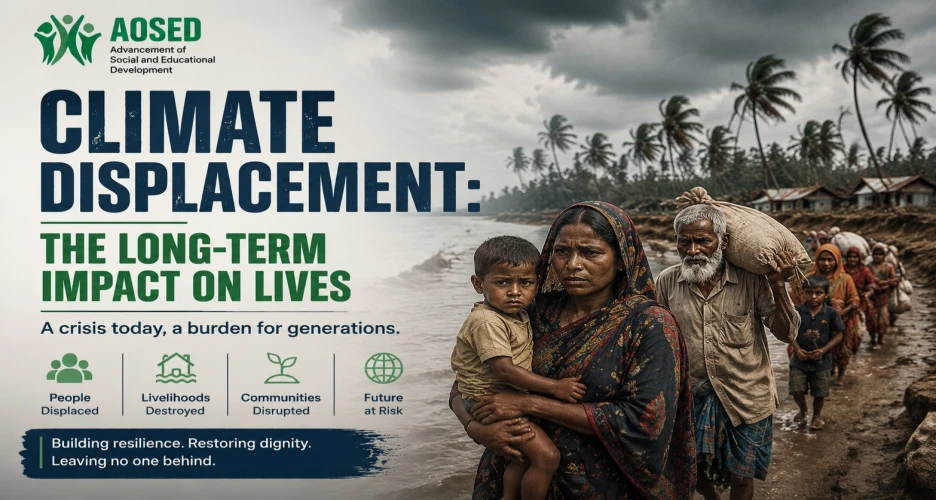
Climate Displacement: Leaving a Long-Term Impact
For people living in Bangladesh's coastal regions, natural disasters often feel like a silent death trap. Without warning, the sky darkens, fierce winds begin to roar, and an ominous signal of impending catastrophe spreads across the horizon. In those moments, people find themselves standing between life and death, trapped in a state of uncertainty. Some manage to escape the deadly storm and return to the light of life, while others disappear forever into silent darkness.
The waves of saline water sweep away homes, possessions, and every cherished memory of a lifetime. What remains are only shock, grief, and destitution. Some families lose their loved ones, while others see the hard work of an entire lifetime destroyed in a single moment. They stand on devastated land, yet their cries, sorrow, and silent suffering rarely reach the ears of people living far away.
From Prosperity to Poverty in a Single Day
There was a time when Mobarak Hossain owned 22 bighas of land, where he cultivated shrimp. He also operated a large grocery store in the local market. His livelihood included fishing in the Sundarbans and collecting honey from the forest. His extended family lived together in a compound consisting of ten permanent houses, always filled with activity and laughter. As a respected community leader, he enjoyed both social status and financial security.
However, everything changed in 2009, when Cyclone Aila struck the southwestern coast of Bangladesh. In a single blow, the cyclone swept away everything he had built over a lifetime. Overnight, a wealthy and respected man became destitute.
Today, nothing remains of his ancestral home. Even the graves of his parents, grandparents, and forefathers have disappeared beneath the river. He cannot even stand before their graves to mourn them. The massive tidal surge brought by Cyclone Aila erased not only his home but also the emotional connection to generations of family history.
Although sixteen years have passed, Mobarak Hossain's family has never been able to fully recover or return to a normal life.
His home was located in Pata Jorasingh Village of Dakshin Bedkashi Union, Koyra Upazila, Khulna District. Along the northeastern edge of the village flows the Shakbaria River, beyond which lies the Sundarbans, the world's largest mangrove forest.
On 25 May 2009, Cyclone Aila made landfall along Bangladesh's southwestern coast. During the cyclone, tidal waters rose 8–10 feet higher than normal, breaching flood-control embankments across the region. Hundreds of villages were inundated as embankments collapsed, forcing thousands of families from their homes.
With nowhere to stay, many displaced families migrated to districts such as Khulna, Dhaka, Faridpur, Rangamati, and other parts of the country. Mobarak Hossain's family was among them. The embankment directly in front of his house collapsed under the pressure of the tidal surge.
The day after the disaster, having lost everything, he boarded a trawler with his family and sought shelter in Khulna City. Even there, life offered little relief. He faced repeated harassment and deception. At a time when he had no home, no food, and not even adequate clothing, he received almost no meaningful assistance. Because of political differences, he says neither government nor non-government organizations came forward to help his family. They endured severe hardship and uncertainty.
Today, Mobarak Hossain lives in Kusharhula Village, Bhandarpara Union, Dumuria Upazila, Khulna. After sixteen years of struggle, he has managed to build another modest home. Living in a simple house with a tin roof and bamboo fencing, he continues to dream of rebuilding a peaceful life despite losing everything to climate disaster.
Mobarak Hossain has two sons and one daughter.
Two years before Cyclone Aila struck, his eldest son, Mosharraf Hossain, had completed his Higher Secondary Certificate (HSC) and secured a government job. At the time of the cyclone, his younger son, Motijul Islam, had also passed his HSC examinations and was studying for a bachelor's degree at a college in Khulna. His youngest daughter, Sadia Sultana, was only eight years old.
Because the eldest son already had stable government employment, the family was able to maintain some financial stability after the disaster. However, displacement brought devastating consequences for the younger son. Unable to continue his education, Motijul had to abandon his bachelor's degree before completing it.
Hoping to secure a government job for his younger son, Mobarak paid BDT 200,000 to a fraudster who promised employment. The promised job never materialized, and the money was never returned.
The family suffered another devastating financial blow while trying to send Motijul abroad for work. In 2014, after borrowing money from various sources, Mobarak paid BDT 250,000 to a recruiting agent who promised to arrange employment in Italy. Once again, he was deceived. His son was never sent overseas, and the agent disappeared with the money.
Today, Motijul Islam and his wife work as factory laborers in the Dhaka Export Processing Zone (DEPZ). Because there is no one available to care for their eight-year-old son, the child has been left in the care of his grandfather, Mobarak Hossain.
According to Mobarak, despite his age, his grandson's physical growth has been slower than expected, reflecting the hardships the family continues to endure.
A Community Submerged
Dakshin Bedkashi Union is surrounded by rivers on all sides. To protect local communities from tidal flooding, the Bangladesh Water Development Board (BWDB) had constructed embankments around the area.
When Cyclone Aila struck, several sections of these embankments collapsed under the force of the unusually high tides. As a result, the entire union was inundated with saline seawater. For nearly four years, tidal water flowed in and out of the area with every high and low tide, making normal life virtually impossible.
Recalling the day of the cyclone, Mobarak Hossain becomes visibly emotional. Tears well up in his eyes as he remembers those terrifying moments.
"We watched the river rising higher and higher. Within moments, the water overtopped the embankment. Shortly afterward, the embankment in front of our house collapsed. Fortunately, there was a boat beside the house. Somehow, we managed to get everyone into the boat and reached a safer embankment to save our lives."
He continued:
"We couldn't take anything with us. Everything was swept away. All of our furniture and household belongings were destroyed. The next day, we hired a trawler and left for Khulna with nothing. When we arrived, we were completely destitute. After two days, we survived on relief food. People we knew helped us by giving us old clothes. We lost property worth nearly BDT 5 million during Cyclone Aila. I had once been one of the wealthiest people in the area, but within a single day I became poor."
Different Paths After the Disaster
Although Mobarak Hossain has managed to rebuild part of his life over the past sixteen years, his neighbor Anwar Ali has not been as fortunate.
The two families had once lived side by side. While Mobarak left for Khulna the day after Cyclone Aila, Anwar Ali remained in the village. He owned a large shop beside his home, but after the cyclone destroyed everything, he and thirteen family members, including relatives from his wife's family, lived inside the damaged shop for nearly one and a half years.
Eventually, he too was forced to leave the area.
Today, Anwar Ali lives with his in-laws near Koya Bazaar in Dumuria Upazila, Khulna. To support his family, he now works as a rickshaw puller in Dhaka.
A Village Lost to the River
Satellite images from Google Earth taken in 2008 show that the area destroyed during Cyclone Aila had once been a densely populated settlement.
Using those images, Mobarak Hossain and Anwar Ali identified the locations where their homes once stood.
However, satellite images captured in December 2009 reveal a dramatically different landscape. The settlement had disappeared entirely. A large canal had cut through the middle of the former village, connecting directly with the nearby river. According to local residents, this channel was created when the river broke through the embankment during Cyclone Aila.
Later, around 2013, embankments were constructed around the newly formed waterbody, creating what is now locally known as Hazrat Ali Beel.
The intention was to revisit the original village with both Mobarak Hossain and Anwar Ali to document the current conditions. However, Mobarak was too ill to travel, so only Anwar Ali made the journey.
Returning to his former village became an emotional experience. Local residents rushed toward him—some calling him uncle, others brother or friend. He walked through the area, pointing out where his home had once stood and where his shop had been before everything was swallowed by the river.
Children Displaced by Climate Change Are Not Doing Well
Kashem Sardar's home was in Bania Village, Koyra Upazila. After Cyclone Amphan struck in 2020, his family could no longer remain in their village. Forced to leave, he moved to Khulna City with his two sons and one daughter.
Today, they live in a rented house in the Sabujbagh area of Bagmara, Khulna. Kashem earns a living by driving a battery-powered van, but his income is insufficient to support the family. As a result, he has been compelled to send both of his sons to work instead of school.
His eldest son, Abdur Rahim Badsha, is around 15–16 years old and has a mild physical disability. He studied up to Grade Five before dropping out.
His younger son, Hossain Sardar, is only eight years old.
Instead of attending school every morning, Hossain now spends his days selling popcorn, chanachur, peanuts, and fried snacks in front of different schools in the Nirala area.
When asked about his work, the young boy simply replied:
"This is my business. My father put me into this work."
His mother, Latifa Parvin, explained that the family migrated to Khulna three years ago after becoming climate-displaced in search of work.
When asked why Hossain was no longer attending school, she said:
"We can barely feed our children. We simply can't afford to educate all of them. Sending him to school would require additional expenses. That's why we had to send him to work instead. At least he can earn something and help the family survive."
Her words reflect the painful choices many climate-displaced families are forced to make—where survival takes precedence over education and childhood.
What Does the Research Say?
The number of internally displaced people (IDPs) in Bangladesh due to natural disasters has increased steadily over the past four years.
According to the Global Report on Internal Displacement 2025, published by the Internal Displacement Monitoring Centre (IDMC), nearly 2.4 million people were internally displaced in Bangladesh during 2024 as a result of natural disasters. This places Bangladesh fifth in the world in terms of disaster-related internal displacement.
The report notes that flooding and tropical cyclones are the primary drivers of displacement across the country.
The figure represents a significant increase compared to 2023, when approximately 1.8 million people were displaced by disasters. Bangladesh also ranked fifth globally that year.
Within a single year, the number of internally displaced people increased by approximately 600,000, reaching 2.4 million—the third-highest annual total ever recorded for Bangladesh.
The report notes that only 2019, when severe flooding occurred, and 2020, when flooding combined with Cyclone Amphan, recorded higher levels of disaster-induced displacement.
Research conducted after Cyclone Aila in Khulna, Satkhira, and Barguna found that approximately 500,000 people were displaced by the disaster.
In these three coastal districts alone, thousands of families permanently lost their homes and land.
According to organizations working on internal displacement under the United Nations, a significant proportion of these displaced people have still not been able to return to their original villages.
The World Bank's 2021 Groundswell Report projects that, by 2050, more than 13 million people in Bangladesh could become internally displaced due solely to the impacts of climate change.
Among the areas identified as being at highest risk are the coastal regions of Khulna, where rising sea levels, cyclones, salinity intrusion, and river erosion continue to threaten communities and livelihoods.
This growing body of evidence highlights that climate displacement in Bangladesh is no longer a temporary humanitarian challenge. It has become a long-term development issue affecting livelihoods, education, public health, social protection, and the future of millions of vulnerable people.
Natural Disasters Are Expected to Increase in Bangladesh
Scientists have issued new warnings about Bangladesh's climate future.
A team of researchers from the Department of Earth, Atmospheric and Planetary Sciences at the Massachusetts Institute of Technology (MIT) has found that the country faces an increasing risk of severe tropical cyclones in the coming decades.
According to the researchers, storms that historically occurred once every 100 years could occur as frequently as once every 10 years under future climate conditions. The level of risk will vary depending on geographical location and seasonal conditions.
These findings were published in the U.S.-based scientific journal One Earth on 11 April 2025, highlighting Bangladesh as one of the countries most vulnerable to the impacts of climate change.
The researchers emphasized an important message:
"The most important takeaway is that we can no longer rely solely on historical observations to understand future risks. The climate has already changed, and the frequency of extreme weather events is increasing."
Their analysis suggests that by the end of this century, storms previously considered once-in-a-century events could occur every decade—or even more frequently.
A Call for Immediate Action
One of the study's authors, Sai Ravela, Principal Research Scientist in MIT's Department of Earth, Atmospheric and Planetary Sciences, stressed that Bangladesh requires:
- Advanced climate-risk modelling;
- The latest scientific research;
- Strong international cooperation; and
- Immediate adaptation measures.
He noted that the findings are not only relevant to Bangladesh but also to other vulnerable delta and coastal regions, including Vietnam, southern China, Indonesia, and similar low-lying areas around the world.
Cyclones Are Becoming More Powerful
Bangladesh experienced three cyclones during 2023—Cyclone Mocha, Cyclone Hamoon, and Cyclone Midhili.
Climate experts consider three major cyclones affecting the country within a single year to be highly unusual.
Meteorologists explain that while the overall number of cyclones in the Bay of Bengal may not be increasing significantly, the intensity of major storms is growing.
As ocean temperatures continue to rise due to climate change, the Bay of Bengal stores more heat energy. Warmer sea-surface temperatures provide additional fuel for tropical cyclones, enabling them to become stronger and more destructive.
Trends in Cyclone Activity
Historical records from 1948 to 2023 reveal significant variations in cyclone formation in the Bay of Bengal:
| Period | Number of Major Cyclones |
|---|---|
| 1948–1962 | 20 |
| 1963–1977 | 52 (highest) |
| 1978–1992 | 30 |
| 1993–2007 | 22 |
| 2008–2022 | 24 |
Although the frequency of cyclone formation has fluctuated over the decades, scientists warn that the likelihood of stronger and more destructive cyclones is increasing as the climate continues to warm.
Meteorologists attribute this trend to rising temperatures over both the Bay of Bengal and the surrounding landmass. These changing conditions create an environment more favorable for the development of intense tropical cyclones.
Scientific Evidence Points to Greater Future Risks
A 2021 study by NASA's Center for Climate Simulation (NCCS), titled "Exploring Past and Future Tropical Cyclones in the Bay of Bengal with High-End Computing," also warns of significant future changes.
The study concludes that:
- Climate change may alter the expected number of cyclones forming in the Bay of Bengal.
- Stronger cyclones are likely to develop in the northern Bay of Bengal during the post-monsoon season.
- These storms are expected to have serious consequences for Bangladesh, India, and Myanmar.
Conclusion
The experiences of families like Mobarak Hossain, Anwar Ali, and Kashem Sardar demonstrate that climate change is not merely an environmental issue—it is a profound human crisis.
Cyclones, tidal surges, river erosion, and salinity intrusion continue to destroy homes, livelihoods, education, and social networks, forcing countless families to abandon their ancestral lands.
Research indicates that millions of Bangladeshis have already been displaced, and scientific projections suggest that many millions more may be forced to move in the coming decades if climate change continues unabated.
For Bangladesh, climate displacement is no longer a future concern. It is an ongoing reality that demands coordinated action in disaster preparedness, climate adaptation, social protection, sustainable livelihoods, and long-term policy planning.
Only through sustained investment in resilience, inclusive development, and international cooperation can vulnerable communities hope to rebuild their lives and face the future with dignity.